Pokazywanie postów oznaczonych etykietą HAIKU JOURNALS | MAGAZINES. Pokaż wszystkie posty

13.02.2013

Spider by Czesław Milosz | Pająk Czesława Miłosza

Pająk i śmierć to dwa przyciągające się wzajemnie byty.

Śmierć - ona snuła się i snuje przez wersy niezliczonych utworów.

Pająk - bohater wielu haiku, którego można znaleźć również i w niejednym tekście - staje się niezwykle istotną istotą poniższego miłoszowskiego wiersza:


Mój dom ma dwie łazienki. Zostawiam pająka
W nie używanej wannie i wracam do moich zajęć.

Czesław Miłosz, Pająk (w. 30-31)


My house has two bathrooms. I leave the spider
in an unused tub and return to my matters.

The Spider, Czesław Miłosz (ll. 35-36)
(ll. 30-31)
(trans. by myself)

Kilka bardzo prostych informacji.


Parę wersów później znajdujemy, tym razem inną, ale również niezwykle ascetyczną informację: to dwuwers będący haikowym obrazem (i zarazem ilustracją zasady nieszkodzenia):


Nazajutrz zaglądam do mego pająka,
Martwy, zwinięty w czarną kulkę na lśniącej bieli.

(w. 35-36)

One day after I look in on my spider,
Dead, curled into a black dot on the shiny whiteness.

The Spider, Czesław Miłosz (ll. 35-36)
(trans. by myself)

W dramacie umierania - jak radził nam nasz noblista rok przed podjęciem pracy na Uniwersytecie w Berkeley -  miłosierdzie winno być rzeczą naturalną:


A jednak Ziemi należy się, nieduża choćby, tkliwość.
Jest bardzo dużo śmierci i dlatego tkliwość
dla warkoczy, spódnic kolorowych na wietrze,
łódeczek papierowych nie trwalszych niż my sami.

(Rady, UP 314) 

And yet, the Earth deserves even a little sentiment.
There is a lot of death and that's why a sentiment
for braids, colorful skirts on the wind,
for paper boats not more lasting than we ourselves.

(Advices, Cz. Miłosz, 1959)

(trans. by myself)

Toteż w kontekście Rad jakże inaczej wybrzmiewa powyższy pająkowy dwuwers (w. 35-36): wyraźne odmówienie mu gestu czułości dzięki działaniu (zaniechaniu działania) właściciela wanny, jednoznaczne odmówienie owej tkliwości wobec skazanego tym samym na śmierć pająka.

Spójrzmy na inną pełzającą istotę, na inną, jakże klarowną - by nie rzec "czystą"  - śmierć:

lather, rinse, repeat . . .
a tiny spider goes down
in the swirl

Kathy Lippard Cobb 
(Modern Haiku 34.3 Awards; the summer 2003 issue of Modern Haiku):

piana, płukanie i ponownie . . .
pajączek tonie
w wodnym wirze
(trans. by myself)


Czy takie było pajaków przeznaczenie? Gdzie zatem podziała się zasada ahinsy?

15.12.2012

The first number of Bones - a journal for contemporary haiku | Pierwszy numer Bones - a journal for contemporary haiku

The first number of Bones - a journal for contemporary haiku is already out and waiting for the readers.
  
The editors of this internet-based magazine have chosen my shoelace to be included in this first issue.

misty crossway
tying tighter
my shoelace

Bones journal, no.1 December 2012 

I am particular pleased by virtue of the so special fact that it was my virgin submission to any print or internet-based haiku magazine in my whole haiku life (exceptions: the DailyHaiga and the Mainichi).

So, now being in the journal-published author's shoes, I feel comfortable all the way.

Having my sholace tied tighter and striding along my haiku path. . . maybe I wouldn't trip.:-)

My rethanking to the editors of  Bones for their decision.


Pierwszy numer nowego internetowego magazynu Bones - a journal for contemporary haiku jest już dostępny i czeka na swoich czytelników.

Edytorzy wybrali do tego inauguracyjnego numeru moje sznurowadło (my shoelace).

rozstaje we mgle
wiążę mocniej
moje sznurowadło

misty crossway
tying tighter
my shoelace

Bones journal, no.1 December 2012 

Jest mi szczególnie miło ze względu na fakt, że to było moje dziewicze przedłożenie moich trójwersów do jakiegokolwiek magazynu haiku (wyjątek: The Daly Haiga i The Mainichi).

No cóż, będąc teraz w butach opublikowanego autora, czuję się nad wyraz wygodnie.

Zawiązawszy mocniej  sznurowadło, krocząc własną haikową drogą. . . być może się nie potknę.

Chciałbym wyrazić moje ponowne podziękowania dla edytorów za podjętą decyzję.


25.09.2012

A brand new haiku journal


Bones

a journal for new haiku


— a brand new haiku journal, which is seeking for all kind of a haiku style:
“Gendai haiku / New haiku i.e haiku written from, within, for the 21st century and based in/sprung from the haijin's cultural, linguistic and historic reality. Haiku that takes the language seriously enough to be willing to blow it apart from the inside in order to show/discover/reveal new meanings and echoes. Haiku that stands on the firm ground of tradition but has internalized it and is now written for today and the future. Exploitative haiku. Connective haiku. In the West haiku can be fruitfully pollinated by what is called fragmentary poetry/short poetry/micro poetry. We are constantly asking the question: what is haiku in the 21st century and what can it become if it's not to fall in with the carpet and be a neat little thing you do with your left hand and read on get well-cards? ... if it's not to repeat the already repeated stuff. Single haiku & serial haiku. Haiku that dares claim its own language, imagery, space and now. Experiments of every kind. Surreal haiku. Fantastic haiku. Conceptual haiku in both form and content."

WEBSITE: Bones
YEARS: 2012–
FORMAT: online
FREQUENCY: 2 p/yr
ISSUES: 2012: No 1 (November 15) 
               2013: No
ISSUES AVAILABLE ONLINE:
FOUNDER:
EDITOR/S: Sheila Windsor
                   Alan Summers
                   Johannes S. H. Bjerg
PUBLISHER:
COUNTRY: INTERNATIONAL
SUBMISSIONS: guidelines
                           with "Submission to bones" in the subject line, the works in the body of 
                           the email and as an attached file (doc, docx, odt, rtf)
                        E-mail: http://www.bonesjournal.com/submission.html
                        Address: undisclosed
                        Online form: NONE
DEADLINES: November 15 & May 15 (for haiku)
READING PERIOD: for essays; articles; papers – all-year round
PUBLISHES: Gendai haiku (new haiku); every kind of haiku; essays; articles; papers on new haiku
ACCEPTS: a maximum of 10 single haiku and/or 2 series/sequences of maximum 12 haiku; 
                 previously unpublished (works having been through an editorial process [by someone
                 else than the author him/herself] are considered as published, works published on
                 social media or private blogs are not considered published)
SUBSCRIPTIONS: internet publication
PAYMENTS: NONE
REVIEWS:
OTHER INFO: All rights remains with the author(s)


9.07.2012

The inaugural issue of Multiverses


The inaugural issue of Multiverses: a journal of haiku and related form is alive!


a word from the editor


First and foremost, I owe each and every one of you who submitted, had work accepted or have been looking forward to the first issue of this journal a very substantial apology and, to some extent, an explanation.

I originally hoped to publish Multiverses 1.1 on March 21, which is now exactly three months ago to the day. In the weeks leading up to that initial release date, events took place in my life that not only made working on the issue nearly impossible, but also put haiku, poetry, and all other pursuits of pleasure, interest and curiosity far from my mind. (If you wish to know more, please send me an email at johnhawkpoetry@gmail.com.)

Without proper resources of time and computer access to fully complete the layout of the issue, and being unable in good conscious to delay the issue any further, I have decided to publish our inaugural issue—in its entirety—with the haiku section consisting of a PDF of accepted poems. The other sections have been completed, and I hope you enjoy the look and feel of our online journal. I plan to layout the haiku section in due time, but I believe the poems themselves are vivid and exceptional enough to stand on their own without placement within our website design. I hope you feel the same.

I want especially to thank my fellow editors for their incredible support and unending patience through this difficult time, and to also thank all who queried and messaged to check on my status as well as the journal’s. More information will come shortly regarding the future of Multiverses, as no decisions have been made going forward.

So without further delay: Fellow enthusiasts of haiku and its related forms, I apologize for the lengthy wait, but am extremely proud to present to you the first issue of Multiverses.
                                                                            
                                                                              Sincerely,

                                                                       John Hawk
                                                                              Founding Editor


Congratulations for all editors!

 Enjoyment for the readers!


The inaugural issue of Multiverses 1.1. 2012

4.06.2012

A child is a real cosmos | Dziecko to prawdziwy kosmos


In the beginner's mind there are many possibilities, in the expert's mind there are few.
Shunryu Suzuki

(trans. by myself)


Dorota Pyra
DailyHaiga - 02.06.2012 
Dorota Pyra's blog: rozsypany-czas 

A child is indeed a real cosmos (vide: Dorota Pyra's astonishing haiga).
And its imagination—a planet not discovered to the end, which attracts ideas straight from its childish knowledge.


patyk i kamień
dzisiaj znów moje dziecko
stwarza świat

stick and stone
today my child again
creates a world


The hero of Dorota's lovely haiku–THE CHILD–playing with things already well known in prehistory (a stick and pebble) is able to create on the sand or on a small piece of ground ITS OWN WORLD.
It is the world perhaps even without adjectives; it is still the world of chaotic lines and geometric shapes, but also it is the world in which a stick changes into a magic wand, and the child becomes a magician of possibilities.

From the point of view of child (as well as of an adult) the world seems to be an eternity, which he/she experiences every moment, and which the child sees during encounter with the rule of chaos constantly modified by childish possibilities in the course of its daily play.

It is just in it that the seed of the art lies.

Dziecko to prawdziwy kosmos | A child is a real cosmos


English Version: A child is a real cosmos


W umyśle początkującego jest wiele możliwości, u eksperta jedynie kilka.
Shunryu Suzuki
(tł. L.Sz.)


Dorota Pyra
DailyHaiga - 02.06.2012 
Dorota Pyra's blog: rozsypany-czas 


Dziecko to rzeczywiście prawdziwy kosmos (vide: niesamowita haiga Doroty).
A jego wyobraźnia - nieodkrytą do końca planetą przyciągająca pomysły prosto z dziecięcej wiedzy.


patyk i kamień
dzisiaj znów moje dziecko
stwarza świat


stick and stone
today my child again
creates a world


Bohater wspaniałego haiku Doroty - DZIECKO - z zabawy przedmiotami dostępnymi już w prehistorii (kamień i patyk) potrafi wykreować na piasku, na kawałku ziemi, SWÓJ ŚWIAT.

To świat być może nawet jeszcze i bez przymiotników; to jeszcze świat chaotycznych linii i geometrycznych kształtów, ale to świat, w którym patyk staje się czarodziejską różdżką, a dziecko - magiem możliwości.

Z perspektywy dziecka (jak też i dorosłego) świat wydaje się być wiecznością, którą doświadcza co chwilę, i którą zaznaje podczas spotkania zasady chaosu nieustannie modyfikowaną dziecięcymi możliwościami w trakcie codziennej zabawy.

To właśnie w niej tkwi zalążek sztuki.

1.06.2012

The new issue of Haidan (The Haiku Stage), May 2012 | Najnowszy numer japońskiego magazynu Haidan (Haikowa scena)

Najnowszy numer japońskiego magazynu Haidan  (Haikowa scena).
Oh, gdybym tylko znał japoński,  mógłbym...

The newest issue of Haidan (The Haiku Stage).
Ah, if I only knew Japanese, I could...

Haidan 2012 May Issue [Magazine]

14.03.2012

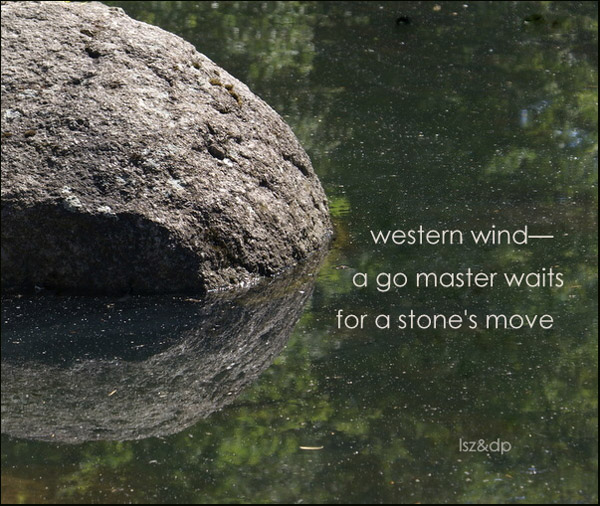
Daily Haiga - Dorota Pyra's haiga with western wind | haiga Doroty Pyry z zachodnim wiatrem

Wyjątkowa - jak dla mnie - haiga Doroty Pyry ukazała się dzisiaj w Daily Haiga:
So special, as for me, Dorota Pyra's haiga appeared today in the Daily Haiga:


Leszek Szeglowski (Poet)

14 March 2012
---
Poem Text or Excerpt:
western wind—
a go master waits
for a stone’s move

zachodni wiatr –
mistrz go czeka

na ruch kamienia

Creator:
Publication Notes:
The haiku won Honorable Mention in the 15th Mainichi Haiku Contest 2011.


Obraz nie ilustrując narzucającego się odczytania haiku dodaje nową warstwę interpretacji.

Her image not illustrating imposed reading of the haiku, adds a new layer of interpretation.

7.02.2012

Jacek Margolak's style: another plagiarized haiga (part 12)

The most comprehensive post about this addicted plagiarizer:


42 cases of plagiarisms or copyright infringements
by Jacek Margolak

(2005-2012)


Kolejny plagiat Jacka Margolaka.

Here's another plagiarism by Jacek Margolak.
This "artist" for many years has treated the whole world of haiku and haiga with an absolute cruel contempt.


source:
Dajesz +1 publicznie. Cofnij
haikuworld.blox.pl

Witryna z tym zdjęciem | Website with this photo


On the Jacek Margolak's blog we can read his post:

piątek, 30 maja 2008
Haiga z haiku opublikowanym na Asahi Haikuist Network.
9:29, jacek_jaal

[Friday, May 30, 2008
Haiga with haiku published in: Asahi Haikuist Network (May 30, 2008)
9:29 AM jacek jaal (nick of Jacek Margolak)
transl. by myself]


The AHN editor, David Mc Murray wrote:

Glittering
an old bridge handrail
spring sunrise

Jacek Margolak woke up early and went for a walk over an old bridge near his home in Kielce, Poland.
source: Asahi Haikuist Network

Actually, this old bridge isn't near Kielce, Poland.

The picture of this footbridge we can find on many sites:


"footbridge"

26.01.2012

Ion Codrescu: Haïga, Peindre en poésie | 100 haig Iona Codrescu


to return
or not to return
– winter twilight

Such doubt is still coming back. But my haiku question above also has returned in a book of haiga by Ion Codrescu Haïga, Peindre en poésie; 2012.

It's actually paradoxical comeback: from Birth ( DailyHaiga 18 January 2010: First publication) to Death (Anthology - Dreams Wander On: Contemporary Poems of Death Awareness, edited by Robert Epstein; 2011), and again to Life (Ion Codrescu: Haïga, Peindre en poésiem; 2012).

Well, three times a charm. This should be an illustration of "And how to don't believe in proverbs".

But let's return to a specific charm of Ion Codrescu's artistic book (100 his haiga  with haiku of authors from 15 countries).

The book in which the real Master of Haiga meticulosly aranging the ideal of integrating words and images. His art is indeed a perfect invitation for contemplative souls.


revenir
ou ne pas revenir
– crepuscule d'hiver

(haiku translated into French by I. Codrescu)


to return
or not to return
– winter twilight

(transl by myslf)

wrócić
albo nie wrócić
– zimowy zmierzch


The special symbolism of this haiga (for I remember still Dorota Pyra's haisha with my haiku - a shell in a hand) is augmented by two leaves that are just before my eyes. And this peculiar opposition between the whiteness and blackness, between the twilight and light.

Two leaves on the way to discover the point of tangency of Life and Death.

to return
or not to return
– winter twilight

Have I found the answer?
I don't know.
Yet.


If that includes you, then check out the video presentation of HAIGA BOOK that is available here:

It is worth of your time.


to return
or not to return
– winter twilight

Taka wątpliwość nieustannie powraca. Ale też i pytanie zawarte w haiku również powróciło w książce Iona Codrescu Haïga, Peindre en poésiem; 2012)

Właściwie to paradoksalny powrót: od Narodzin ( DailyHaiga 18. 01. 2010: pierwsza publikacja) do Śmierci (Antologia - Dreams Wander On: Contemporary Poems of Death Awareness, ed. Robert Epstein; 2011)
i ponownie do Życia (Ion Codrescu: Haïga, Peindre en poésie: 2012).

No cóż, do trzech razy sztuka. To niczym ilustracja: 'I jak tu nie wierzyć w przysłowia'.

Powróćmy jednakże do specyficznej sztuki zawartej w książce Iona Codrescu.
Książki, w której prawdziwy Mistrz Haigi starannie zaaranżował wcielenie integracji słowa z obrazem. Jego sztuka jest rzeczywiście wspaniałym zaproszeniem dla refleksyjnych dusz.


revenir
ou ne pas revenir
– crepuscule d'hiver

(haiku translated into French by I. Codrescu)

to return
or not to return
– winter twilight

(transl by myslf)

wrócić
albo nie wrócić
– zimowy zmierzch


Wyjątkowej symboliki tej haidze (wciąż pamiętam bowiem haishę Doroty z moim haiku) dodaje  fakt, że przed naszymi oczyma znajdują się jedynie dwa liście. I ta specyficzna opozycja między bielą a czernią, między zmierzchem a jasnością.

Dwa liście na drodze ku odszukaniu punktu styczności życia ze śmiercią.

to return
or not to return
– winter twilight

Czy znalazłem odpowiedź?
Nie wiem.
Jeszcze.

Zainteresowanych zapraszam na prezentację (video) HAIGA BOOK (100 haig autorstwa Iona Codrescu, haiku autorów z 15 krajów) udosętpnioną tutaj: http://grazielladupuy.over-blog.com/.
Naprawdę warto.

23.01.2012

The big signs SOPA have appeared on the website of Modern Haiga for Jacek Margolak | Znak STOPU na stronie Modern Haiga dla Jacka Margolaka (cz.11)

The most comprehensive post about this addicted plagiarizer:


42 cases of plagiarisms or copyright infringements
by Jacek Margolak

(2005-2012)


Two big signs have appeared on the website of Modern Haiga Tanka Press:
Stop Online Piracy Act.

Wonder, who and when put these SOPA signs up there?
Who and when removed Jacek Margolak's plagiarized haiga from MH?

No comments!
 

beekopia     lilieskopia
"beekopia" Copyright © 2008 by Jacek Margolak; Kielce, Poland.
"lilieskopia" Copyright © 2008 by Jacek Margolak; Kielce, Poland. 

[source: 


I have already found more than 10 such cases (please, see lebel) of cheating the haiga magazines (Daily Haiga, Sketchbook) and the judge of WHA Haiga Contest Kuniharu Shimizu by Master Haiga Artist Jacek Margolak.

A lot of plagiarisms are on Jacek Margolak's blog, too. How many? Who knows?


Ciekawe, kto i kiedy umieścił te dwa znaki SOPA (STOP znak przeciwko internetowemu piractwu) na stronie Modern Haiga - w ten sposób zniknęły haigi-plagiaty Jacka Margolaka beekopia oraz  lilieskopia.


Bez komentarza!


"beekopia" Copyright © 2008 by Jacek Margolak; Kielce, Poland.
  ]]

10.01.2012

A new online journal of haiku and other forms of Japanese poetry: Multiverses | Nowy internetowy magazyn poświęcony haiku i innym japońskim formom poetyckim: Multiverses

Wishing the editorial crew of Multiverses all the best for your many, many years on the Web!

 
Multiverses: a journal of haiku and related forms

— “Multiverses is an online literary journal featuring haiku and related forms.
Our editorial goal is simply to publish the best poetry we receive on a quarterly basis.
We hold no prejudice toward traditional styles or structure, nor do we shy away from work that may be considered avant-garde or experimental.”
[source: http://www.multiversesjournal.com/about.html]

WEBSITE:
Multiverses
YEARS: 2012-present
FORMAT: Webzine
FREQUENCY: 4 p/yr
ISSUES AVAILABLE ONLINE:
FOUNDER: John Hawk
EDITOR/S: Paul Smith – tanka editor, Melissa Allen – haibun editor, Alexis Rotella – haiga editor, Johannes. S. H. Berg – features editor
PUBLISHER:
COUNTRY: USA
SUBMISSION: guidelines
                        E-mail: multiversesjournal(at)gmail(dot)com
                        Address:
                        Online form: yes
DEADLINES:
                        
February 1 (Spring issue);
                         May 1 (Summer issue);
                         August 1 (Fall issue);
                         November 1 (Winter issue);
READING PERIOD:
PUBLISHES: Haiku, senryu, tanka, haibun, haiga
ACCEPTS: Previously published material will not be considered for publication. (Works that appear on social media or personal blog sites will still be eligible for inclusion in Multiverses.)
SUBSCRIPTION:
REVIEWS:
OTHER INFO: “We are unable to pay contributor fees for accepted work at this time. Multiverses acquires first publishing rights to all accepted work and reserves the right to archive past issues on its website. All other rights revert to the author or artist upon publication. When reprinting online or in print, please cite Multiverses as the original publisher.” [source: http://www.multiversesjournal.com/submissions.html]

13.12.2011

Another mask in Daily Haiga | Kolejna maska w Daily Haiga

W dzisiejszej przepięknej masce-haidze - opublikowanej na stronie Daily Haiga odkryłem słowa niosące symboliczne przesłanie.

Rayzan Pintea wykreował dzieło, które nie potrafi zamaskować prostej i czystej prawdy.

Przepiękna.
Dziękuję, Rayzan.


In the today's beautiful mask-haiga, published in the Daily Haiga, I found the words carrying a symbolic envoy.

Rayzan Pintea has created his art that can not mask the straight and pure truth.

I love it. 
Thank you so much, Rayzan, for that.


13 December 2011

Poem Text or Excerpt:

winter sunset
the masks hide their colors
then disappear


Creator:


zimowy zachód słońca
maski ukrywają swe kolory
i znikają

zimowy zachód słońca
maski ukrywają swe kolory
a potem znikają

(transl. Lech Sz.)

8.12.2011

Znowu Daily Haiga i Jacek Margolak - jak to nazwiemy? (cz.4) - Another plagiarism by Jacek Margolak in Daily Haiga (part 4)

The most comprehensive post about this addicted plagiarizer:


42 cases of plagiarisms or copyright infringements
by Jacek Margolak

(2005-2012)


Nadchodzi zima:


Proszę wejść na poniższą stronę, znajduje się  tam płot - upadający płot (4 zdjęcie w pokazie slajdów).


TERMS OF USE

The free wallpaper downloads on this site are for personal use on computer screens only. They may not be redistributed, offered for sale, included on CDs, or used for printed material. We do offer licensing packages. Click here for details.

Warunki użycia zdjęcia:

Zabronione!!! Chyba, że się miało licencję.


 A oto dzieło Jacka Margolaka w DAILY HAIGA:


7 March 2010

year’s end
the weight of snow
on an old fence


Jacek - broniony zaciekle przez Admina Polskiego Forum Edukacyjnego HAIKU ABC Grzegorza Sionkowskiego (w jakże charakterystyczny dla siebie sposób), który to Admin okresla Jacka Margolaka mianem najwybitniejszego  haijina w Polsce. 


A moje -
w perfidny sposób zmanipulowane i zasugerowane przez Grzegorza do interpretacji -zdanie:

"To również jeden z organizatorów Pierwszego Międzynarodowego Polskiego Konkursu Haiku: szata graficzna internetowej strony jest jego autorstwa."

miało na celu wyciągnięcie jednego jedynego wniosku: to wstyd dla Polskiego Środowiska Haikowego, że Jacek Margolak firmuje swoim nazwiskiem Pierwszy Międzynarodowy Polski Konkurs Haiku.

Ale to dla Admina "krótka piłka" - i ma "dość sporu mojego z Jackiem".